
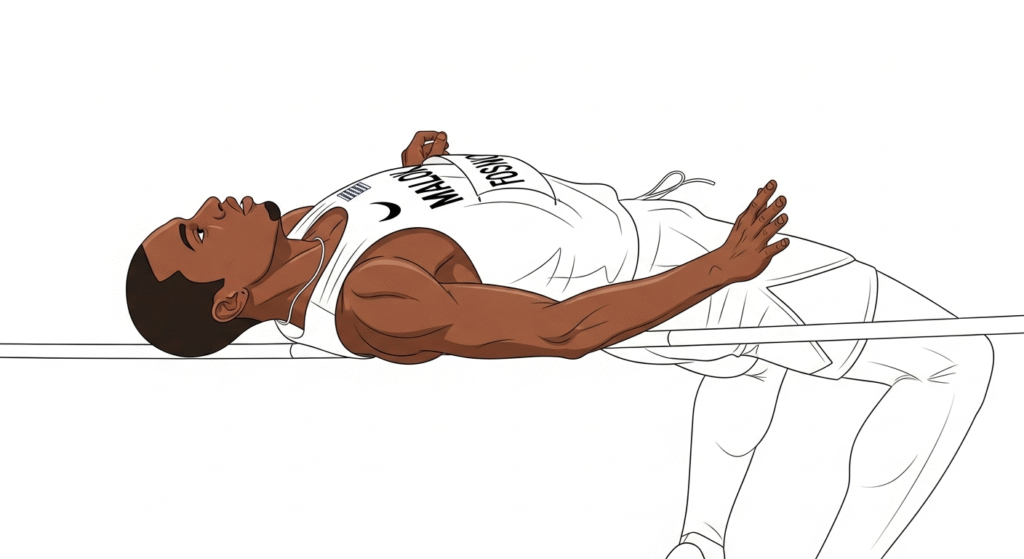
Breaking Through High Jump Plateaus: Diagnosing and Fixing Stalled Progress
You hit 5'10" three weeks ago. You've been training consistently, doing everything your coach said. But the bar won't go higher. You've attempted 6'0" fifteen times across multiple sessions, and you're not even close.
This is a plateau. Not a failure, not a ceiling on your potential—just a signal that something in your training, technique, or recovery needs adjustment. The problem is figuring out what.
This article walks through the five most common causes of high jump plateaus and provides specific diagnostic tests to identify which one is affecting you. Once you know the cause, the solution becomes clear.
The Five Primary Plateau Causes
Plateaus don't happen for mysterious reasons. They happen because one or more systems in your training is no longer creating adaptation. Here are the usual suspects:
- Insufficient strength/power base – You lack the raw force production needed to clear higher bars.
- Technical breakdown under load – Your technique deteriorates as heights approach your maximum.
- Inadequate recovery – You're accumulating fatigue faster than you're adapting.
- Programming issues – Your training lacks appropriate progressive overload or periodization.
- Psychological barriers – Mental blocks prevent execution of jumps you're physically capable of making.
Most plateaus involve multiple factors. A strength limitation creates technical breakdown. Technical breakdown creates inconsistency. Inconsistency creates psychological doubt. But there's usually one primary cause that, when addressed, unlocks progress again.
Diagnostic Test 1: Strength/Power Assessment
If you can't generate enough force at takeoff, technical refinement won't help. You need more horsepower in the engine.
Signs This Is Your Issue
- Your vertical jump has not improved in 8+ weeks despite consistent training
- You clear bars easily at 85% of your PR but struggle at 90%+
- Your takeoff feels sluggish even when technique is correct
- You've added 2-3 inches to your PR in the past year but haven't increased your squat, power clean, or depth jump performance
Testing Protocol
Measure these three markers over a 2-week period:
1. Countermovement vertical jump: Stand beside a wall, jump and touch as high as possible. Measure the difference between standing reach and jumping reach. If this hasn't increased in 2+ months, strength/power is likely your limitation.
2. Approach jump vs. standing vertical jump ratio: Your approach jump should add 8-12 inches to your standing vertical. If the difference is less than 6 inches, you're not converting approach speed into vertical force efficiently—often a power issue.
3. Strength indicators: Back squat should be at least 1.5x bodyweight for high school athletes, 1.8-2.0x for college level. If you're below these thresholds, strength is limiting.
Solution: Power Development Phase
If strength/power is your bottleneck, reduce jump volume by 30-40% and dedicate 6-8 weeks to targeted strength and plyometric work. The 12-Week Plyometric Plan provides structured progression from basic to advanced power exercises.
Sample 6-Week Power Phase:
Week 1-2: Strength foundation – heavy squats (5x3 at 85%), Romanian deadlifts, single-leg work. Jump volume: 20-25 attempts per week at 80-85% of PR.
Week 3-4: Power conversion – reduce strength volume by 30%, add depth jumps, box jumps, bounds. Jump volume: 30-35 attempts, with focus on takeoff explosiveness.
Week 5-6: Integration – maintain strength 1x per week, plyometrics 2x per week, increase jump volume to 40-45 attempts with progressive heights.
Research on plyometric training and vertical jump development consistently shows that structured power programs can add 2-4 inches to vertical jump within 8 weeks.
Diagnostic Test 2: Technical Breakdown Analysis
Technical plateaus are the most common type. You have the strength to clear the height, but your technique falls apart when the bar gets high.
Signs This Is Your Issue
- You clear 80-85% of your PR easily with good form, but technique changes noticeably at 90%+
- Your approach run becomes inconsistent (plant foot position varies by more than 15cm) at max heights
- You knock the bar down in the same place repeatedly (e.g., always with your trail leg)
- Coaches or video analysis reveal different body positions at max heights vs. submaximal jumps
Testing Protocol
Film 5 consecutive jumps at each of these heights: 80%, 85%, 90%, 95% of your current PR. Watch for these specific breakdowns:
Approach inconsistency: Measure plant foot distance from the bar on each jump. Variation greater than 10cm indicates approach breakdown.
Takeoff mechanics: Compare takeoff leg angle and free leg drive between 80% and 95% jumps. If your takeoff knee collapses more at higher heights or your free leg swing becomes rushed, technique is breaking down.
Bar clearance: Note where contact occurs. Front shoulder = early rotation. Trail leg = late leg tuck. Hips = insufficient arch or timing issue.
Solution: Isolation Drills and Progressive Loading
Technical plateaus require reducing the complexity of the jump while fixing the specific flaw. Don't keep attempting max heights with broken technique—you're just reinforcing bad patterns.
Fixing Approach Inconsistency
Spend 2-3 weeks doing approach runs with no bar. Mark your ideal plant position with tape. Run the approach 20-30 times per session, aiming to land within 5cm of the mark every time. Only add the bar back when consistency is established.
Fixing Takeoff Breakdown
Use short approach or 3-step approaches at 70-75% of PR height. Focus exclusively on explosive takeoff with proper body lean. Film every session. Progress back to full approach only when takeoff mechanics remain consistent across all heights.
Fixing Bar Clearance Issues
The Bar Clearance Checklist breaks down common clearance problems with specific drill corrections for each phase—from approach through landing.
Get Specific Technical Fixes
The Bar Clearance Checklist identifies 12 common technical breakdowns with targeted drills to address each one. Stop guessing what's wrong and start fixing it systematically.
Download the ChecklistDiagnostic Test 3: Recovery and Adaptation
You might be training too much, too hard, too often. Overreaching (short-term excessive load) can create plateaus. Overtraining (long-term accumulated fatigue) can cause performance regression.
Signs This Is Your Issue
- Training feels harder than it used to—weights feel heavier, jumps feel sluggish
- Sleep quality has declined (difficulty falling asleep, waking frequently)
- Resting heart rate is elevated 5+ beats above normal
- Motivation for training has dropped noticeably
- Minor aches and pains that don't resolve with 1-2 days rest
Testing Protocol
Track these three markers for two weeks:
Morning resting heart rate: Measure immediately upon waking, before getting out of bed. If it's elevated 5+ bpm above your normal baseline, you're not recovering adequately.
Vertical jump performance: Test once per week, first thing in the morning after a rest day. Declining performance over 2-3 consecutive weeks signals cumulative fatigue.
Training volume log: Count total jump attempts per week. If you're consistently above 50-60 full approach jumps per week without adequate recovery weeks, you're likely overreaching.
Solution: Structured Recovery Week
If recovery is the issue, taking a full week off isn't the answer. You need a structured deload that maintains fitness while allowing adaptation.
7-Day Recovery Protocol:
Days 1-2: Complete rest or very light movement (walking, swimming, stretching).
Days 3-5: Low-intensity technical work. Approach runs with no bar, 10-15 jumps at 70% of PR focusing on rhythm and consistency. Light gym work (2 sets of 3 at 70% of normal weights).
Days 6-7: Return to normal training volume but keep intensity at 80-85% of max.
After the recovery week, resume progressive training but implement regular deload weeks—every 3-4 weeks, reduce volume by 40-50% while maintaining intensity.
Diagnostic Test 4: Programming Deficiencies
Sometimes plateaus happen because your training lacks structure. You're doing the same workouts week after week with no progressive overload, or you're changing things randomly without a clear progression.
Signs This Is Your Issue
- Your training looks the same now as it did 8 weeks ago (same exercises, same sets/reps, same jump volumes)
- You don't have a written training plan or competition schedule
- You jump max heights every session with no variation in intensity
- Your strength program hasn't changed in months
Testing Protocol
Review your training log for the past 8 weeks. Answer these questions:
1. Is there progressive overload? Week 8 should show higher volume or intensity than week 1. If not, your program lacks progression.
2. Do you have distinct training phases? Strength phase, power phase, competition phase. If every week looks identical, you're not periodizing.
3. Is intensity varied? Some sessions should be at 80-85%, some at 90-95%, some at 95%+. If you're always jumping 95%+, you're burning out.
Solution: Implement Periodization
Structure your training into clear phases with specific goals. The periodization framework provides templates for organizing training across the season.
Basic 12-Week Progression Out of a Plateau:
Weeks 1-4: Strength foundation phase. Jump volume 30-35 attempts per week at 75-85% of PR. Strength work 3x per week. No max attempts.
Weeks 5-8: Power development phase. Jump volume 40-45 attempts at 80-90% of PR. Strength work 2x per week. Plyometrics 2x per week. Introduce 1-2 max attempts per week.
Weeks 9-12: Competition preparation. Jump volume 35-40 attempts at 85-95%+ of PR. Strength maintenance 1x per week. Max attempts 2x per week. Week 12 is a deload before testing new PR.
Diagnostic Test 5: Psychological Barriers
Sometimes the limitation isn't physical. You have the strength, the technique is solid, and you're recovered. But when the bar goes to a new height, something changes mentally.
Signs This Is Your Issue
- You clear heights in practice that you miss in competition
- There's a specific height that you've failed at repeatedly and now anticipate missing
- Your approach run changes when attempting a PR (rushed, hesitant, or altered rhythm)
- You can clear 95% of your PR easily but have failed 30+ attempts at your PR height
- Negative self-talk increases as bar height increases
Testing Protocol
This one requires honest self-assessment:
Mental rehearsal test: Close your eyes and visualize clearing a height 6 inches above your PR. If you can't complete the visualization without imagining failure, you have a mental barrier.
Performance anxiety assessment: Rate your anxiety on a 1-10 scale at different bar heights. If anxiety jumps significantly (3+ points) when approaching max heights, mental factors are limiting performance.
Comparison of training vs. competition performance: If you consistently perform 4-6 inches better in training than competition, psychological pressure is a factor.
Solution: Systematic Desensitization and Mental Skills Training
Mental barriers require direct mental training, not more physical reps.
Visualization Protocol
Spend 10 minutes daily visualizing successful jumps at and above your current PR. Include all sensory details—the feel of the approach, the sound of the bar rattling but not falling, the landing on the mat. This builds mental familiarity with success at heights you haven't cleared yet.
Progressive Exposure
Set the bar at your PR height at the beginning of every session, even if you don't attempt it. Walk through the approach multiple times. Desensitize yourself to the visual of the bar at that height. After 2-3 weeks, start attempting it early in the session when you're fresh—not as the final jump when fatigue has accumulated.
Process Goals Over Outcome Goals
Instead of "clear 6'0" today," focus on "execute three jumps with perfect approach rhythm." When your focus shifts from the outcome to the process, pressure decreases. See our guide on setting effective high jump goals for more on this approach.
Implementing Your Diagnosis
Most plateaus involve multiple factors. You might have a strength limitation that's causing technical breakdown, which has created a mental barrier. The key is identifying the primary cause and addressing it first.
Your Action Plan
Week 1: Run all five diagnostic tests. Identify which 1-2 factors are most clearly limiting your progress.
Week 2-4: Implement the specific solution protocol for your primary limitation. Reduce training complexity—focus on fixing one thing, not everything at once.
Week 5-8: Once the primary limitation improves, address secondary factors. If strength was the main issue and you've added 3 inches to your vertical jump, now refine technique at the new power level.
Week 9+: Return to full competition preparation with the fixes integrated. Test a new PR attempt only after you've seen consistent improvement in submaximal heights.
Remember: Plateaus are not permanent. They're diagnostic information. Use them to identify what needs adjustment, make the change, and progress resumes. Athletes who never plateau are either not pushing their limits or aren't training long enough to encounter them. View plateaus as expected checkpoints in development, not failures.
Build Structured Strength for Breakthrough Performance
If strength/power deficiency is your limitation, the Strength Training Workout Cards provide progressive loading protocols specifically designed for high jumpers—from foundational strength through explosive power development.
Get the Training CardsFor additional support in addressing plateaus, explore our resources on injury prevention (if recovery is an issue) and foundational drill work (if technique needs rebuilding from the ground up).